Sunday, September 11, 2016

1011-01 b Abbasid Caliphate


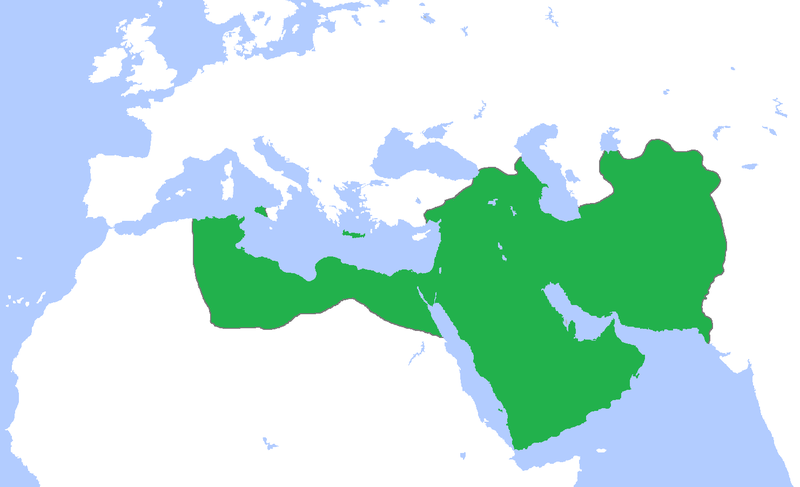
File:Abbasids850.png

Abbasid Caliphate

The Abbasid Caliphate (/əˈbæsᵻd/ or /ˈæbəsᵻd/ Arabic: الخلافة العباسية‎‎al-Khilāfah al-‘Abbāsīyah) was the third of the Islamic caliphates to succeed the Islamic prophet Muhammad. The Abbasid dynasty descended from Muhammad's youngest uncle, Abbas ibn Abd al-Muttalib (566–653 CE), from whom the dynasty takes its name.[1] They ruled as caliphs, for most of their period from their capital in Baghdadin modern-day Iraq, after assuming authority over the Muslim empirefrom the Umayyads in 750 CE (132 AH).
The Abbasid caliphate first centered its government in Kufa, but in 762 the caliph Al-Mansur founded the city of Baghdad, north of theSasanian capital city of Ctesiphon. The choice of a capital so close toPersia proper reflected a growing reliance on Persian bureaucrats, most notably of the Barmakid family, to govern the territories conquered by Arab Muslims, as well as an increasing inclusion of non-Arab Muslims in the ummah. Despite this initial cooperation, the Abbasids of the late 8th century had alienated both Arab mawali[2] and Iranian bureaucrats,[3] and were forced to cede authority over Al-Andalus and Maghreb to the Umayyads, Morocco to the Idrisid dynasty,Ifriqiya to the Aghlabids, and Egypt to the Shi'ite Caliphate of theFatimids. The political power of the caliphs largely ended with the rise of the Buyids and the Seljuq Turks. Although Abbasid leadership over the vast Islamic empire was gradually reduced to a ceremonial religious function, the dynasty retained control over its Mesopotamian demesne. The capital city of Baghdad became a center of science, culture, philosophy and invention during the Golden Age of Islam.
This period of cultural fruition ended in 1258 with the sack of Baghdadby the Mongols under Hulagu Khan. The Abbasid line of rulers, and Muslim culture in general, recentered themselves in the Mamluk capital of Cairo in 1261. Though lacking in political power, the dynasty continued to claim authority in religious matters until after the Ottomanconquest of Egypt 

1011-01 a Caliphate


Caliphate


A caliphate (Arabic: خِلافة‎‎ khilāfa) is an area containing an Islamic stewardknown as a caliph (Arabic: خَليفة‎‎ khalīfah About this sound pronunciation )—a person considered a religious successor to the Islamic prophet,Muhammad (Muhammad ibn ʿAbdullāh), and a leader of the entire Muslim community.[1] The Rashidun caliphs, who directly succeeded Muhammadas leaders of the Muslim community, were chosen through shura, a process of community consultation that some consider loosely to be an early form of Islamic democracy.[2] During the history of Islam after theRashidun period, many Muslim states, almost all of them hereditary monarchies, have claimed to be caliphates.[1] Even though caliphs were thought to go back to Muhammad, they were not thought of as having the same prophetic power as he did.[3]
The Sunni branch of Islam stipulates that, as a head of state, a caliph should be elected by Muslims or their representatives.[4] Followers of Shia Islam, however, believe a caliph should be an Imam chosen by God from the Ahl al-Bayt (the "Family of the House", Muhammad's direct descendants).

1011-01 Arab–Byzantine wars


The Arab–Byzantine wars were a series of wars between the mostly Arab Muslims and the East Roman or Byzantine Empirebetween the 7th and 11th centuries AD, started during the initialMuslim conquests under the expansionist Rashidun and Umayyadcaliphs in the 7th century and continued by their successors until the mid-11th century.
The emergence of Muslim Arabs from Arabia in the 630s resulted in the rapid loss of Byzantium's southern provinces (Syria andEgypt) to the Muslim Caliphate. Over the next fifty years, under the aggressive Umayyad caliphs, the Muslims would launch repeated raids into still-Byzantine Asia Minor, twice threaten the Byzantine capital, Constantinople with conquest, and outright conquer the Byzantine Exarchate of Africa. The situation did not stabilize until after the failure of the Second Arab Siege of Constantinople in 718, when the Taurus Mountains on the eastern rim of Asia Minor became established as the mutual, heavily fortified and largely depopulated frontier. Under the Abbasid Empire, relations became more normal, with embassies exchanged and even periods of truce, but conflict remained the norm, with almost annual raids and counter-raids, sponsored either by the Abbasid government or by local rulers, well into the 10th century.

During the first centuries, the Byzantines were usually on the defensive, and avoided open field battles, preferring to retreat to their fortified strongholds. Only after 740 did they begin to launch counterstrikes of their own, but still the Abbasid Empire was able to retaliate with often massive and destructive invasions of Asia Minor. With the decline and fragmentation of the Abbasid stateafter 861 and the concurrent strengthening of the Byzantine Empire under the Macedonian dynasty, the tide gradually turned. Over a period of fifty years from ca. 920 to 976, the Byzantines finally broke through the Muslim defences and restored their control over northern Syria and Greater Armenia. The last century of the Arab–Byzantine wars was dominated by frontier conflicts with the Fatimids in Syria, but the border remained stable until the appearance of a new people, the Seljuk Turks, after 1060.
The Muslims also took to the sea, and from the 650s on, the entireMediterranean Sea became a battleground, with raids and counter-raids being launched against islands and the coastal settlements. Muslim raids reached a peak in the 9th and early 10th centuries, after conquests of Crete, Malta and Sicily, with their fleets reaching the coasts of France and Dalmatia and even the suburbs of Constantinople.

1011 BYZANTINE EMPIRE timeline

http://www.thelatinlibrary.com/imperialism/notes/byzantinechron.html

CHRONOLOGY OF BYZANTINE EMPIRE (330-1453 A.D.)
330 AD:   Constantine founds the new capital of the Roman Empire on the existing site of the ancient Greek city Byzantium:   Byzantium was renamed Constantinople and it would become the capital of the Byzantine Empire.
395:   The Roman Empire divides in half, with the Eastern Roman Empire based in Constantinople and the Western Roman Empire based in Rome/Ravenna.
476:   The Western Empire Falls:   The Eastern Empire survives and now is labeled as the Byzantine Empire.
526:   Justinian's reign begins. He reconquers parts of the fallen Western Empire (Africa and Italy, Spain). He codifies the Previous Roman Laws into one document. Constantinople is the most glorious city in europe, with 500,000 inhabitants. The Hagia Sofia is constructed. Justinian is the last emperor to use the title "Caesar".
568:   Lombards invade Italy, eventually taking Northern Italy from the Byzantines.
610:   Heraclius becomes emperor. Temporary possession of Mesopotamia. The theme system is installed. The Empire's language changes to Greek. Eventual Lost of Syria, Palestine, and Egypt to Muslims.
693:   Muslims attack Constantinople.
690:   Loss of North Africa to Muslims.
717-718:   A large Muslim force besiege Constantinople by land and sea. The attack is held off.
721:   Regains control of Asia Minor from the Muslims
726:   Emperor Leo III bans the use of Icons.
800:   Charlemagne, king of the Franks, is crowned "Emperor of the Romans" by Pope Leo III in Rome. For the first time in 300 years, there is an emperor of the "East" and an emperor of the "West".
843:   The use of Icons is restored.
917:   Bulgars under Symeon overrun Thrace.
924:   Bulgars unsuccessfully attack Constantinople unsuccessfully.
941:   Prince Igor of Kiev attacks Bithynia and later attacks Constantinople: The Byzantines destroys the Russian fleet.
976:   Basil II becomes Emperor.
992:   Venetians granted extensive trading rights in the Byzantine Empire
995:   Basil II reconquers Syria from the Muslims.
996:   Basil II reconquers Greece from Bulgars.
1014:   Basil II destroys the Bulgar army, earning the epithet Bulgaroktonos ("Bulgar Slayer").
1055:   Loss of southern Italy to the Normans.
1071:   Defeat at Manzikert to the Seljuk Turks. Permanent loss of most of Asia Minor.
1075:   Loss of Syria to Muslims.
1054:   The Great Schism: The Latin Roman Church and the Greek Orthodox Church excommunicate each other.
1087:   Byzantines defeated in Thrace.
1095:   Alexius appeals to Urban II at Council of Piacenza for help against the Turks. The First Crusade is proclaimed at Council of Clermont.
1096:   Crusaders arrive at Constantinople. The Crusaders are successful, but eventually withdraw from cooperation with the Byzantines.
1121:   Reconquest of southwestern Asia Minor.
1179:   Byzantine Army defeated by the Sultanate of Rum at Myriokephalon. Hopes of regaining Asia Minor are lost.
1202:   Fourth Crusade is assembled at Venice.
1204:   Fourth Crusade captures Constantinople. The Latin Empire of Constantinople is formed as well as many Byzantine successor states. The capture of Constantinople in 1204 was a blow from which the Byzantines never fully recovered.
1261:   The successor state of Nicaea recaptures Constantinople and restores the Byzantine Empire.
1453:   Fall of Constantinople to the Ottomans. End of the Byzantine Empire.

100-12 JJustinian I byzantine emperor


Justin II

Justin II (Latin: Flavius Iustinus Iunior Augustus;[1] Ancient Greek:Φλάβιος Ἰουστίνος ὁ νεώτερος; c. 520 – 5 October 578) was Eastern Roman Emperor from 565 to 574. He was the husband of Sophia, nephew of Justinian I and the Empress Theodora, and was therefore a member of the Justinian Dynasty. His reign is marked by war with Sasanian Iran and the loss of the greater part of Italy. He presented the Cross of Justin II toSaint Peter's, Rome.

Accession[edit]

Justinian I died on the night of 14 to 15 November 565. Callinicus (pl), the praepositus sacri cubiculi, seems to have been the only witness to his dying moments, and later claimed that Justinian had designated "Justin, Vigilantia's son" as his heir in a deathbed decision. The clarification was needed because there was another nephew and candidate for the throne, Justin, son of Germanus. Modern historians suspect Callinicus may have fabricated the last words of Justinian to secure the succession for his political ally.[2] As Robert Browning (a modern historian, not the poet) observed: "Did Justinian really bring himself in the end to make a choice, or did Callinicus make it for him? Only Callinicus knew."[3]
In any case, Callinicus started alerting those most interested in the succession, originally various members of theByzantine Senate. Then they jointly informed Justin and Vigilantia, offering the throne. Justin accepted after the traditional token show of reluctance, and with his wife Sophia, he was escorted to the Great Palace of Constantinople. The Excubitors blocked the palace entrances during the night, and early in the morning, John Scholasticus, Patriarch of Constantinople, crowned the new Augustus. Only then was the death of Justinian and the succession of Justin publicly announced in the Hippodrome of Constantinople.[4]
Both the Patriarch and Tiberius, commander of the Excubitors, had been recently appointed, with Justin having played a part in their respective appointments, in his role as Justinian's curopalates. Their willingness to elevate their patron and ally to the throne was hardly surprising.[4]
In the first few days of his reign Justin paid his uncle's debts, administered justice in person, and proclaimed universal religious toleration. Contrary to his uncle, Justin relied completely on the support of the aristocratic party.

100-11 JJustinian I byzantine emperor

File:Justinien 527-565.svg

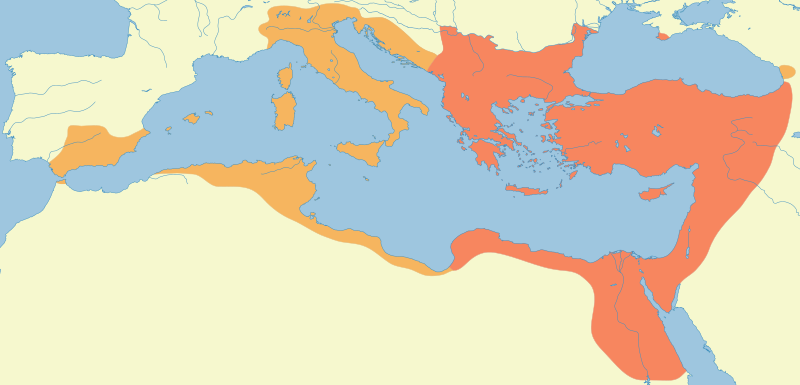
The Byzantine Empire had its first golden age under the Justinian Dynasty, which began in 518 AD with the Accession of Justin I. Under the Justinian Dynasty, the Empire reached its largest territorial point, reincorporating North Africa, southern Illyria, southern Spain, and Italy into the Empire. The Justinian Dynasty ended in 602 with the deposition of Maurice and the ascension of his successor, Phocas.

Early life and accession to the throne[edit]

The Justinian Dynasty began with the accession of its namesake Justin I to the throne. Justin I was born in a small village, Bederiana, in the 450s AD.[1] Like many country youths, he went to Constantinople and enlisted in the army, where, due to his physical abilities, he became a part of the Excubitors, the palace guards.[2] He fought in the Isaurian andPersian wars, and rose through the ranks to become the commander of the Excubitors, which was a very influential position. In this time, he also achieved the rank of senator. After the death of the Emperor Anastasius, who had left no clear heir, there was much dispute as to who would become emperor.[3] To decide who would ascend the throne, a grand meeting was called in the hippodrome. The Byzantine Senate, meanwhile, gathered in the great hall of the palace. As the senate wanted to avoid outside involvement and influence, they were pressed to quickly select a candidate; however, they could not agree. Several candidates were nominated, but were rejected for various reasons. After much arguing, the senate chose to nominate Justin; and he was crowned by the Patriarch of Constantinople John of Cappadocia on 10 July.[2]


100-10 Justin I byzantine emperor

Justin I (Latin: Flavius Iustinus Augustus, Ancient Greek: Ἰουστίνος; 2 February 450 – 1 August 527) was Eastern Roman Emperor from 518 to 527. He rose through the ranks of the army and ultimately became Emperor, in spite of the fact he was illiterate[1] and almost 70 years old at the time of accession. His reign is significant for the founding of theJustinian Dynasty that included his eminent nephew Justinian I and for the enactment of laws that de-emphasized the influence of the old Roman nobility. His consort was Empress Euphemia.

Justin was a peasant and a swineherd by occupation[2] from the region of Dardania, which is part of the Prefecture of Illyricum.[3] He was born in a hamlet Bederiana near Scupi (modern Skopje, Macedonia).[2][4] He was of Thraco-Roman[5][6][7] or Illyro-Roman stock,[8][9][10][11][12][13][14][15] spoke rudimentary Greek, and bore, like his companions and members of his family (Zimarchus, Dityvistus, Boraides, Bigleniza, Sabbatius, etc.), a Thracian name, Istok.[8][16] His sister Vigilantia (b. ca 455) married Sabbatius and had two children: Petrus Sabbatius Justinianus (b. 483) andVigilantia (b. ca 490), married to Dulcissimus and had Praejecta (b. ca 520), married to the senator Areobindus andJustin II (b. ca 520).
As a teenager, he and two companions fled from a barbaric invasion, taking refuge in Constantinople possessing nothing more than the ragged clothes on their backs and a sack of bread between them. Justin soon joined the army and, because of his ability, rose through the ranks to become a general under the Emperor Anastasius I; by the time of Anastasius' death in 518, he held the influential position of comes excubitorum, commander of the palace guard

Emperor[edit]

Thanks to his position commanding the only troops in the city and making gifts of money, Justin was able to secure election as emperor in 518.
A career soldier with little knowledge of statecraft, Justin wisely surrounded himself with trusted advisors. The most prominent of these, of course, was his nephew Flavius Petrus Sabbatius, whom he adopted as his son and invested with the name Iustinianus (Justinian).
Justin's reign is noteworthy for the resolution of the Acacian Schism between the eastern and western branches of the Christian church. Justin endorsed Rome's view on the question of the dual nature of Christ and the more general principle of Roman supremacy. This temporary eastern deferral to the western church did not endure.
Relying upon the accounts of the historian Procopius, it often has been said that Justinian ruled the Empire in his uncle's name during the reign of Justin; however, there is much evidence to the contrary. The information from theSecret History of Procopius was published posthumously. Critics of Procopius (whose work reveals a man seriously disillusioned with his rulers) have dismissed his work as a severely biased source, being vitriolic and pornographic, but without other sources, critics have been unable to discredit some of the assertions in the publication. However, contrary to the Secret History, Justinian was not named as successor until less than a year before Justin's death and he spent 3,700 pounds of gold during a celebration in 520.[18]
In 525, Justin repealed a law that effectively prohibited a member of the senatorial class from marrying women from a lower class of society, including the theatre, which was considered scandalous at the time. This edict paved the way for Justinian to marry Theodora, a former mime actress, and eventually resulted in a major change to the old class distinctions at the Imperial court. She became an equal to Justinian, participating in the governance with significant influence.

Later years[edit]

The latter years of the reign of Justin were marked by strife among the Empire, the Ostrogoths, and the Persians. In 526, Justin's health began to decline and he formally named Justinian as co-emperor and, on 1 April 527 as his successor. On 1 August of that year, Justin died and was succeeded by Justinian.