http://www.historyworld.net/wrldhis/PlainTextHistories.asp?ParagraphID=emh
HISTORY OF THE HOLY ROMAN EMPIRE
Holy Roman Emperor: 800
In 799, for the third time in half a century, a pope is in need of help from the Frankish king. After being physically attacked by his enemies in the streets of Rome (their stated intention is to blind him and cut out his tongue, to make him incapable of office), Leo III makes his way through the Alps to visit Charlemagne at Paderborn.
It is not known what is agreed, but Charlemagne travels to Rome in 800 to support the pope. In a ceremony in St Peter's, on Christmas Day, Leo is due to anoint Charlemagne's son as his heir. But unexpectedly (it is maintained), as Charlemagne rises from prayer, the pope places a crown on his head and acclaims him emperor.
Charlemagne expresses displeasure but accepts the honour. The displeasure is probably diplomatic, for the legal emperor is undoubtedly the one in Constantinople. Nevertheless this public alliance between the pope and the ruler of a confederation of Germanic tribes now reflects the reality of political power in the west. And it launches the concept of the new Holy Roman Empire which will play an important role throughout the Middle Ages.
The Holy Roman Empire only becomes formally established in the next century. But it is implicit in the title adopted by Charlemagne in 800: 'Charles, most serene Augustus, crowned by God, great and pacific emperor, governing the Roman empire.'
Emperors and popes: 962-1250
The imperial role accorded by the pope toCharlemagne in 800 is handed on in increasingly desultory fashion during the 9th century. From 924 it falls into abeyance. But in 962 a pope once again needs help against his Italian enemies. Again he appeals to a strong German ruler.
The coronation of Otto I by pope John XII in 962 marks a revival of the concept of a Christian emperor in the west. It is also the beginning of an unbroken line of Holy Roman emperors lasting for more than eight centuries. Otto I does not call himself Roman emperor, but his son Otto II uses the title - as a clear statement of western and papal independence from the other Christian emperor inConstantinople.
Otto and his son and grandson (Otto II and Otto III) regard the imperial crown as a mandate to control the papacy. They dismiss popes at their will and instal replacements more to their liking (sometimes even changing their mind and repeating the process). This power, together with territories covering much of central Europe, gives the German empire and the imperial title great prestige in the late 10th century.
But subservience was not the papal intention in reinstating the Holy Roman Empire. A clash is inevitable.
Papal decline and recovery: 1046-1061
The struggle for dominance between emperor and pope comes to a head in two successive reigns, of the emperors Henry III and Henry IV, in the 11th century. The imperial side has a clear win in the first round.
In 1046 Henry III deposes three rival popes. Over the next ten years he personally selects four of the next five pontiffs. But after his death, in 1056, these abuses of the system bring a rapid reaction. Pope Nicholas II, elected in 1058, initiates a process of reform which exposes the underlying tension between empire and papacy.
In 1059, at a synod in Rome, Nicholas condemns various abuses within the church. These include simony (the selling of clerical posts), the marriage of clergy and, more controversially, corrupt practices in papal elections. Nicholas now restricts the choice of a new pope to a conclave of cardinals, thus ruling out any direct lay influence. Imperial influence is his clear target.
In 1061 the assembled bishops of Germany - the emperor's own faction - declare all the decrees of this pope null and void. Battle is joined. But meanwhile the pope has been enlisting new allies.
In 1059 Nicholas II takes two political steps of a kind, unusual at this period, which will later be commonplace for the medieval papacy. He grants land, already occupied, to recipients of his own choice; and he involves those recipients in a feudalrelationship with the papacy, or the Holy See, as the feudal lord.
This time the beneficiaries are the Normans, who are granted territorial rights in southern Italy and Sicily in return for feudal obligations to Rome. The pope, in an overtly political struggle against the German emperor, is playing a strong hand. The issue will be brought to a head within a few years by another pope, Gregory VII.
Gregory VII and investiture: 1075
Pope Gregory seizes political control by decreeing, in 1075, that no lay ruler may make ecclesiastical appointments. Powerful bishops and abbots are henceforth to be pope's men rather than emperor's men.
The issue becomes known as the investiture controversy, being in essence a dispute over who has the right to invest high clerics with the robes and insignia of office.
The appointment of bishops and abbots is too valuable a right to be easily relinquished by secular rulers. Great feudal wealth and power is attached to these offices. And high clerics, as the best educated members of the medieval community, are important members of any administration.
In subsequent periods compromises are made on both sides, particularly in the Concordat of Worms, in 1122, where a distinction is made between the spiritual and secular element in clerical appointments. But investiture remains a bone of contention between the papacy and lay rulers - not only in the empire, after the first dramatic flare up between Gregory and Henry IV, but also in Franceand England.
Rome and the struggle for power: 1076-1138
The nine-year struggle between pope Gregory VII and the emperor Henry IV provides a vivid glimpse of the political role of the medieval papacy. St Gregory, canonized in theCatholic Reformation, is one of the great defenders of papal power. His career involves incessant power-broking and military struggle.
Henry IV, alarmed at the demands being made over investiture, sends a threatening letter to the pope in 1076. The pope responds by excommunicating the emperor. By his public penance atCanossa, Henry has the excommunication lifted. But the truce is short-lived. Henry's enemies, prompted by the pope's action, take a hand.
German princes opposed to Henry IV elect and crown, in 1077, a rival king - Rudolf, the duke of Swabia. Rudolf and Henry engage in a civil war, which Henry wins in 1080. By then the pope has recognized Rudolf as the German king and has again excommunicated Henry.
This time Henry's response is more aggressive. He summons a council which deposes the pope and elects in his place the archbishop of Ravenna (as pope Clement III). Henry marches into Italy, enters Rome and is crowned emperor by this pope of his own creation. Meanwhile the real pope, Gregory, is living in a state of siege in his impregnable Roman fortress, the Castel Sant'Angelo.
Gregory appeals for help to his vassals theNormans, recently invited by the papacy to conquer southern Italy and Sicily. A Norman army reaches Rome in 1084, drives out the Germans and rescues Gregory. But the Norman sack of the city is so violent, and provokes such profound hostility, that Gregory has to flee south with his rescuers. He dies in 1085 in Sicily.
Clement III returns to Rome and reigns there with imperial support as pope (or in historical terms as antipope) for most of the next ten years. Urban II, the pope who preaches the first crusade in 1095, is not able to enter the holy city for several years after his election. Unrest prevails in Rome, and uncertainty in the empire, until the Hohenstaufen win the German crown in 1138.
Read more:http://www.historyworld.net/wrldhis/PlainTextHistories.asp?ParagraphID=emh#ixzz4Jw0Z0600
Sunday, September 11, 2016

1013 Holy Roman Empire
Holy Roman Empire
The Holy Roman Empire (Latin: Sacrum Romanum Imperium) was a multi-ethnic complex of territories in central Europe that developed during the Early Middle Ages and continued until its dissolution in 1806.[7] The largest territory of the empire after 962 was theKingdom of Germany, though it also came to include the Kingdom of Bohemia, the Kingdom of Burgundy, the Kingdom of Italy, and numerous other territories.[8][9][10]
On 25 December 800, Pope Leo III crowned the Frankish kingCharlemagne as Emperor, reviving the title in Western Europe after more than three centuries. The title continued in the Carolingian family until 888 and from 896 to 899, after which it was contested by the rulers of Italy in a series of civil wars until the death of the last Italian claimant, Berengar, in 924. The title was revived in 962 whenOtto I was crowned emperor, fashioning himself as the successor of Charlemagne[11] and beginning a continuous existence of the empire for over eight centuries.[12][13][14] Some historians refer to the coronation of Charlemagne as the origin of the empire,[15][16] while others prefer the coronation of Otto I as its beginning.[17][18] Scholars generally concur, however, in relating an evolution of the institutions and principles constituting the empire, describing a gradual assumption of the imperial title and role.[9][15]
The precise term "Holy Roman Empire" was not used until the 13th century, but the concept of translatio imperii,[f] the notion that he held supreme power inherited from the emperors of Rome, was fundamental to the prestige of the emperor.[9] The office of Holy Roman Emperor was traditionally elective, although frequently controlled by dynasties. The German prince-electors, the highest-ranking noblemen of the empire, usually elected one of their peers as "King of the Romans", and he would later be crowned emperor by the Pope; the tradition of papal coronations was discontinued in the 16th century. The empire never achieved the extent of political unification formed in France, evolving instead into a decentralized, limited elective monarchy composed of hundreds of sub-units,principalities, duchies, counties, Free Imperial Cities, and other domains.[10][19] The power of the emperor was limited, and while the various princes, lords, bishops and cities of the empire were vassals who owed the emperor their allegiance, they also possessed an extent of privileges that gave them de facto independence within their territories. Emperor Francis II dissolved the empire on 6 August 1806, after the creation of the Confederation of the Rhine byNapoleon.
1012 Charlemagne, king of the Franks
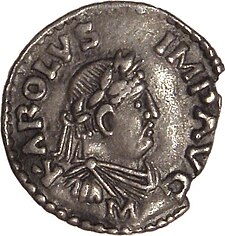
Charlemagne
Charlemagne (/ˈʃɑːrlᵻmeɪn/; 2 April 742/747/748[1] – 28 January 814), also known as Charles the Great (Latin: Carolus or Karolus Magnus) orCharles I (Frankish: *Karl), was King of the Franks. He united a large part of Europe during the early Middle Ages and laid the foundations for modern France, Germany and the Low Countries. He took the Frankish throne in 768 and became King of Italy in 774. From 800, he became the first Holy Roman Emperor—the first recognized emperor in Western Europe since the fall of the Western Roman Empire three centuries earlier. Charlemagne already ruled his kingdom without the help of the Pope, but recognition from the pontiff granted him divine legitimacy in the eyes of his contemporaries
The expanded Frankish state which Charlemagne founded was called theCarolingian Empire.
Charlemagne was the oldest son of Pepin the Short and Bertrada of Laon. He became king in 768 following the death of his father, initially as co-ruler with his brother Carloman I. Carloman's sudden death in 771 under unexplained circumstances left Charlemagne as the undisputed ruler of the Frankish Kingdom. Charlemagne continued his father's policy towards the papacy and became its protector, removing the Lombards from power in northern Italy, and leading an incursion into Muslim Spain. He also campaigned against the Saxons to his east, Christianizing them upon penalty of death, leading to events such as the Massacre of Verden. Charlemagne reached the height of his power in 800 when he wascrowned Emperor of the Romans by Pope Leo III on Christmas Day at Old St. Peter's Basilica.
Charlemagne has been called the "Father of Europe" (Pater Europae),[3]as he united most of Western Europe for the first time since the Roman Empire. His rule spurred the Carolingian Renaissance, a period of energetic cultural and intellectual activity within the Western Church. AllHoly Roman Emperors up to the last Emperor Francis II, as well as both the French and German monarchies, considered their kingdoms to be descendants of Charlemagne's empire.
However, the Eastern Orthodox Church views Charlemagne more controversially, labeling as heterodox his support of the filioque and recognition by the Bishop of Rome as legitimate Roman Emperor rather than Irene of Athens of the Eastern Roman Empire. These were but two of the machinations that led to the eventual split of Rome and Constantinople in the Great Schism of 1054.[4][5]
Charlemagne died in 814, having ruled as emperor for just over thirteen years. He was laid to rest in his imperial capital of Aachen in what is todayGermany. His son Louis the Pious succeeded him
1011-5 Francia or Frankia, also called the Kingdom of the Franks
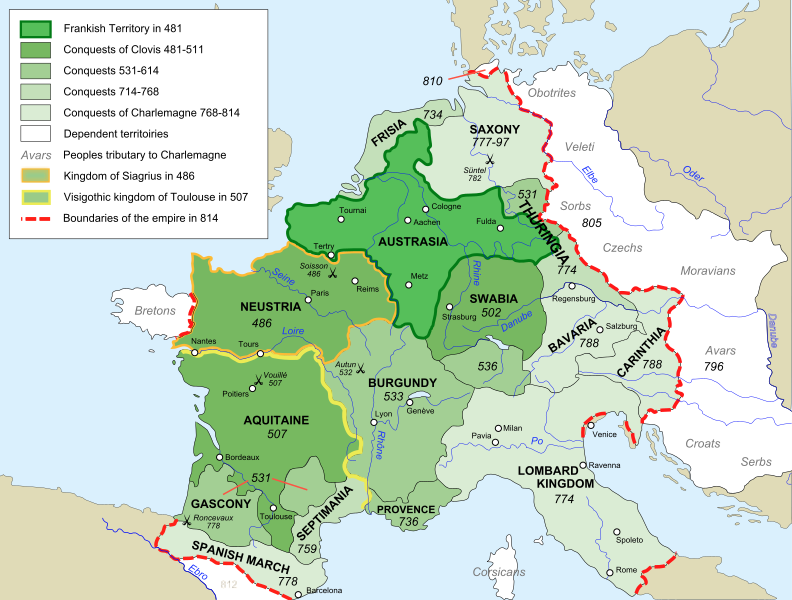
Francia or Frankia, also called the Kingdom of the Franks (Latin:Regnum Francorum), Frankish Kingdom, Frankish Empire,Frankish Realm or occasionally Frankland, was the territory inhabited and ruled by the Franks, a confederation of West Germanic tribes, during Late Antiquity and the Early Middle Ages.
The kingdom was founded by Clovis I, crowned first King of the Franks in 496. Under the nearly continuous campaigns of Pepin of Herstal,Charles Martel, Pepin the Younger, Charlemagne, and Louis the Pious—father, son, grandson, great-grandson and great-great-grandson—the greatest expansion of the Frankish empire was secured by the early 9th century.
The tradition of dividing patrimonies among brothers meant that the Frankish realm was ruled, nominally, as one polity subdivided into several regna (kingdoms or subkingdoms). The geography and number of subkingdoms varied over time, but the particular term Francia came generally to refer to just one regnum, that of Austrasia, centred on the Rhine and Meuse rivers in northern Europe. Even so, sometimes the term was used as well to encompass Neustria north of the Loire and west of the Seine.
Eventually, the singular use of the name Francia shifted towards Paris, and settled on the region of the Seine basin surrounding Paris, which still today bears the name Île-de-France and gave its name to the entire Kingdom of France. Most Frankish Kings were buried in theBasilica of Saint Denis, near Paris. Modern France is still namedFrancia in Spanish and Italian as well as Frankreich in German andFrankrijk in Dutch.
1011-4 Who Were the Ancient Goths?
http://www.livescience.com/45948-ancient-goths.html

/////////////////
/////////////////
he Goths were a people who flourished in Europe throughout ancient times and into the Middle Ages. Referred to at times as “barbarians,” they are famous for sacking the city of Rome in A.D. 410.
Ironically, however, they are often credited with helping preserve Roman culture. After the sacking of Rome, a group of Goths moved to Gaul (in modern-day France) and Iberia and formed the Visigothic Kingdom. This kingdom would eventually incorporate Catholic Christianity, Roman artistic traditions and other aspects of Roman culture. The last Gothic kingdom fell to the Moors in A.D. 711.
Today, the meaning of the word "Goth" has evolved beyond any direct relationship to the ancient Goths. In the late Middle Ages, a style of architecture arose, characterized by large, imposing cathedrals and castles. The term "Gothic" was applied to the style as a critique, the word even at that time being a synonym for "barbaric."
1011-3 Muslim conquest of North Africa
Muslim conquest of the Maghreb
The Muslim conquest of North Africa continued the century of rapid Arab Muslim military expansion following the death ofMuhammad in 632 AD. By 642, the Arabs controlled Mesopotamia,Egypt and Syria, had invaded Armenia, and were concluding their conquest of the Persian Empire with their defeat of the Persian army at the Battle of Nihawānd (Nehawand). It was at this point that Arab military expeditions into North African regions west of Egypt were first launched, continuing for years and furthering the spread of Islam.
In 644 at Madinah, Caliph Umar (Omar) was succeeded by Uthman ibn Affan (Othman), during whose twelve-year rule Armenia,Cyprus, and all of Iran, would be added to the growing Islamic empire; Afghanistan and North Africa would receive major invasions; and Muslim sea raids would range from Rhodes to the southern coasts of the Iberian Peninsula. The Byzantine navy would be defeated in the eastern Mediterranean.
The earliest Arab accounts that have come down to us are those of Ibn Abd-el-Hakem, Al-Baladhuri and Ibn Khayyat, all of which were written in the 9th century some 200 years after the first invasions. These are not very detailed. In the case of the most informative, the History of the Conquest of Egypt and North Africa and Spain by Ibn Abd-el-Hakem, Brunschvig[1] has shown that it was written with a view to illustrating points of Maliki law rather than documenting a history, and that some of the events it describes are probably historical.
Beginning in the 12th century, scholars at Kairouan began to construct a new version of the history of the conquest, which was finalised by ar-Raqiq. This version was copied in its entirety, and sometimes interpolated, by later authors, reaching its zenith in the 14th century with scholars such as Ibn Idhari, Ibn Khaldun and Al-Nuwayri. It differs from the earlier version not only in the greater detail, but also in giving conflicting accounts of events. This, however, is the best-known version and is the one given below.
There is ongoing controversy regarding the relative merits of the two versions. For more information, refer to the works cited below by Brunschvig, Modéran and Benabbès (all supporters of the earlier version) and Siraj (supports the later version).
First invasion[edit]
The first invasion of North Africa, ordered by Caliph Umar, commenced in 647. 20,000 Arabs marched from Medina inArabia, another 20,000 joined them in Memphis, Egypt, and Abdallah ibn al-Sa’ad led them into the ByzantineExarchate of Africa. The army took Tripolitania (in present-day Libya). Count Gregory, the local Byzantine governor,[2]had declared his independence from the Byzantine Empire in North Africa. He gathered his allies, confronted the Islamic invasion force and suffered defeat (647) at the battle of Sufetula, a city 150 miles south of Carthage. With the death of Gregory his successor, probably Gennadius, secured the Arab withdrawal in exchange for tribute. The campaign lasted fifteen months and Abdallah's force returned to Egypt in 648.
All further Muslim conquests were soon interrupted, however, by a civil war between rival Arab factions that resulted in the murder of Caliph Uthman in 656. He was replaced by Ali Ibn Abi Talib, who in turn was murdered in 661. TheUmayyad (Umayyad) Dynasty of largely secular and hereditary Arab caliphs, then established itself at Damascus and Caliph Muawiya I began consolidating the empire from the Aral Sea to the western border of Egypt. He put a governor in place in Egypt at al-Fustat, creating a subordinate seat of power that would continue for the next two centuries. He then continued the invasion of non-Muslim neighbouring states, attacking Sicily and Anatolia (in Asia Minor) in 663. In 664 Kabul, Afghanistan, fell to the invading Muslim armies.
The years 665 to 689 saw a new Arab invasion of North Africa.
It began, according to Will Durant, to protect Egypt "from flank attack by Byzantine Cyrene". So "an army of more than 40,000 Muslims advanced through the desert to Barca, took it, and marched to the neighborhood of Carthage", defeating a defending Byzantine army of 20,000 in the process.
Next came a force of 10,000 Arabs led by the Arab general Uqba ibn Nafi and enlarged by thousands of others. Departing from Damascus, the army marched into North Africa and took the vanguard. In 670 the city of Kairouan (roughly eighty miles or 160 kilometers south of modern Tunis) was established[citation needed] as a refuge and base for further operations. This would become the capital of the Islamic province of Ifriqiya, which would cover the coastal regions of today's western Libya, Tunisia, and eastern Algeria.
After this, as Edward Gibbon writes, the fearless general "plunged into the heart of the country, traversed the wilderness in which his successors erected the splendid capitals of Fes and Morocco, and at length penetrated to the verge of the Atlantic and the great desert". In his conquest of the Maghreb (western North Africa) he besieged the coastal city of Bugia as well as Tingi or Tangier, overwhelming what had once been the traditional Roman province of Mauretania Tingitana.
But here he was stopped and partially repulsed. Luis Garcia de Valdeavellano writes:
Moreover, as Gibbon writes, Uqba, "this Mahometan Alexander, who sighed for new worlds, was unable to preserve his recent conquests. By the universal rebellion against muslim occupation of the Greeks and Africans he was recalled from the shores of the Atlantic." On his return, a Berber-Byzantine coalition ambushed and crushed his forces nearBiskra, killing Uqba and wiping out his troops.
Then, adds Gibbon, "The third general or governor of Africa, Zuheir, avenged and encountered the fate of his predecessor. He vanquished the native population in many battles; but he was overthrown by a powerful army, whichConstantinople had sent to the relief and liberation of Carthage."
Meanwhile, a new civil war among rivals for the monarchy raged in Arabia and Syria. It resulted in a series of four caliphs between the death of Muawiya in 680 and the accession of Abd al-Malik ibn Marwan (Abdalmalek) in 685; strife ended only in 692 with the death of the rebel leader.
1011-2 Second Arab siege of Constantinople

Siege of Constantinople (717–718)
The Second Arab siege of Constantinople in 717–718 was a combined land and sea offensive by the Muslim Arabs of theUmayyad Caliphate against the capital city of the Byzantine Empire, Constantinople. The campaign marked the culmination of twenty years of attacks and progressive Arab occupation of the Byzantine borderlands, while Byzantine strength was sapped byprolonged internal turmoil. In 716, after years of preparations, the Arabs, led by Maslama ibn Abd al-Malik, invaded Byzantine Asia Minor. The Arabs initially hoped to exploit Byzantine civil strife and made common cause with the general Leo III the Isaurian, who had risen up against Emperor Theodosius III. Leo, however, tricked them and secured the Byzantine throne for himself.
After wintering in the western coastlands of Asia Minor, the Arab army crossed into Thrace in early summer 717 and built siege lines to blockade the city, which was protected by the massiveTheodosian Walls. The Arab fleet, which accompanied the land army and was meant to complete the city's blockade by sea, was neutralized soon after its arrival by the Byzantine navy through the use of Greek fire. This allowed Constantinople to be resupplied by sea, while the Arab army was crippled by famine and diseaseduring the unusually hard winter that followed. In spring 718, two Arab fleets sent as reinforcements were destroyed by the Byzantines after their Christian crews defected, and an additional army sent overland through Asia Minor was ambushed and defeated. Coupled with attacks by the Bulgars on their rear, the Arabs were forced to lift the siege on 15 August 718. On its return journey, the Arab fleet was almost completely destroyed by natural disasters and Byzantine attacks.
The siege's failure had wide-ranging repercussions. The rescue of Constantinople ensured the continued survival of Byzantium, while the Caliphate's strategic outlook was altered: although regular attacks on Byzantine territories continued, the goal of outright conquest was abandoned. Historians consider the siege to be one of history's most important battles, as its failure postponed the Muslim advance into Southeastern Europe for centuries.
Subscribe to:
Posts (Atom)