The
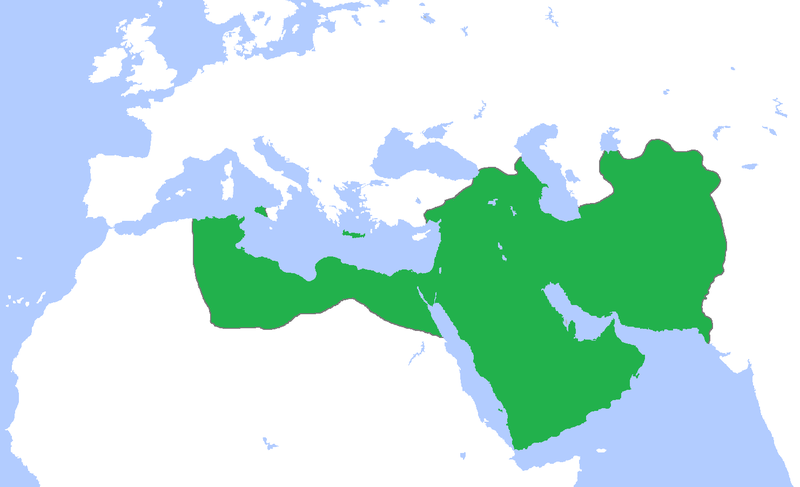
Muslim conquest of North Africa continued the century of rapid
Arab Muslim military expansion following the death of
Muhammad in 632 AD. By 642, the Arabs controlled
Mesopotamia,
Egypt and
Syria, had invaded
Armenia, and were concluding their conquest of the
Persian Empire with their defeat of the Persian army at the
Battle of Nihawānd (Nehawand). It was at this point that Arab military expeditions into North African regions west of Egypt were first launched, continuing for years and furthering the
spread of Islam.
In 644 at Madinah, Caliph
Umar (Omar) was succeeded by
Uthman ibn Affan (Othman), during whose twelve-year rule Armenia,
Cyprus, and all of
Iran, would be added to the growing Islamic empire;
Afghanistan and North Africa would receive major invasions; and Muslim sea raids would range from
Rhodes to the southern coasts of the
Iberian Peninsula. The Byzantine navy would be defeated in the eastern Mediterranean.
The earliest
Arab accounts that have come down to us are those of
Ibn Abd-el-Hakem,
Al-Baladhuri and
Ibn Khayyat, all of which were written in the 9th century some 200 years after the first invasions. These are not very detailed. In the case of the most informative, the
History of the Conquest of Egypt and North Africa and Spain by
Ibn Abd-el-Hakem, Brunschvig
[1] has shown that it was written with a view to illustrating points of
Maliki law rather than documenting a history, and that some of the events it describes are probably historical.
Beginning in the 12th century, scholars at
Kairouan began to construct a new version of the history of the conquest, which was finalised by
ar-Raqiq. This version was copied in its entirety, and sometimes interpolated, by later authors, reaching its zenith in the 14th century with scholars such as
Ibn Idhari,
Ibn Khaldun and
Al-Nuwayri. It differs from the earlier version not only in the greater detail, but also in giving conflicting accounts of events. This, however, is the best-known version and is the one given below.
There is ongoing controversy regarding the relative merits of the two versions. For more information, refer to the works cited below by Brunschvig, Modéran and Benabbès (all supporters of the earlier version) and Siraj (supports the later version).
First invasion[edit]
The first invasion of
North Africa, ordered by Caliph Umar, commenced in 647. 20,000 Arabs marched from
Medina in
Arabia, another 20,000 joined them in
Memphis, Egypt, and
Abdallah ibn al-Sa’ad led them into the Byzantine
Exarchate of Africa. The army took
Tripolitania (in present-day
Libya).
Count Gregory, the local Byzantine governor,
[2]had declared his independence from the
Byzantine Empire in North Africa. He gathered his allies, confronted the Islamic invasion force and suffered defeat (647) at the battle of
Sufetula, a city 150 miles south of
Carthage. With the death of Gregory his successor, probably
Gennadius, secured the Arab withdrawal in exchange for tribute. The campaign lasted fifteen months and Abdallah's force returned to Egypt in 648.
All further Muslim conquests were soon interrupted, however, by a civil war between rival Arab factions that resulted in the murder of Caliph Uthman in 656. He was replaced by
Ali Ibn Abi Talib, who in turn was murdered in 661. The
Umayyad (Umayyad) Dynasty of largely secular and hereditary Arab caliphs, then established itself at Damascus and Caliph
Muawiya I began consolidating the empire from the
Aral Sea to the western border of Egypt. He put a governor in place in Egypt at
al-Fustat, creating a subordinate seat of power that would continue for the next two centuries. He then continued the invasion of non-Muslim neighbouring states, attacking
Sicily and
Anatolia (in Asia Minor) in 663. In 664
Kabul, Afghanistan, fell to the invading Muslim armies.
The years 665 to 689 saw a new Arab invasion of
North Africa.
It began, according to
Will Durant, to protect Egypt "from flank attack by Byzantine Cyrene". So "an army of more than 40,000 Muslims advanced through the desert to
Barca, took it, and marched to the neighborhood of Carthage", defeating a defending Byzantine army of 20,000 in the process.
Next came a force of 10,000 Arabs led by the Arab general
Uqba ibn Nafi and enlarged by thousands of others. Departing from Damascus, the army marched into North Africa and took the vanguard. In 670 the city of
Kairouan (roughly eighty miles or 160 kilometers south of modern
Tunis) was established
[citation needed] as a refuge and base for further operations. This would become the capital of the Islamic province of
Ifriqiya, which would cover the coastal regions of today's western
Libya,
Tunisia, and eastern
Algeria.
After this, as
Edward Gibbon writes, the fearless general "plunged into the heart of the country, traversed the wilderness in which his successors erected the splendid capitals of
Fes and
Morocco, and at length penetrated to the verge of the Atlantic and the
great desert". In his conquest of the
Maghreb (western North Africa) he besieged the coastal city of
Bugia as well as Tingi or
Tangier, overwhelming what had once been the traditional
Roman province of
Mauretania Tingitana.
But here he was stopped and partially repulsed. Luis Garcia de Valdeavellano writes:
In their invations against the Byzantines and the Berbers, the Arab chieftains had greatly extended their African dominions, and as early as the year 682 Uqba had reached the shores of the Atlantic, but he was unable to occupy Tangier, for he was forced to turn back toward the Atlas Mountains by a man who became known to history and legend as
Count Julian.
[citation needed]
Moreover, as Gibbon writes, Uqba, "this Mahometan Alexander, who sighed for new worlds, was unable to preserve his recent conquests. By the universal rebellion against muslim occupation of the Greeks and Africans he was recalled from the shores of the Atlantic." On his return, a Berber-Byzantine coalition
ambushed and crushed his forces near
Biskra, killing Uqba and wiping out his troops.
Then, adds Gibbon, "The third general or governor of Africa,
Zuheir, avenged and encountered the fate of his predecessor. He vanquished the native population in many battles; but he was overthrown by a powerful army, which
Constantinople had sent to the relief and liberation of Carthage."
Meanwhile, a new civil war among rivals for the monarchy raged in Arabia and Syria. It resulted in a series of four caliphs between the death of
Muawiya in 680 and the accession of
Abd al-Malik ibn Marwan (Abdalmalek) in 685; strife ended only in 692 with the death of the rebel leader.